

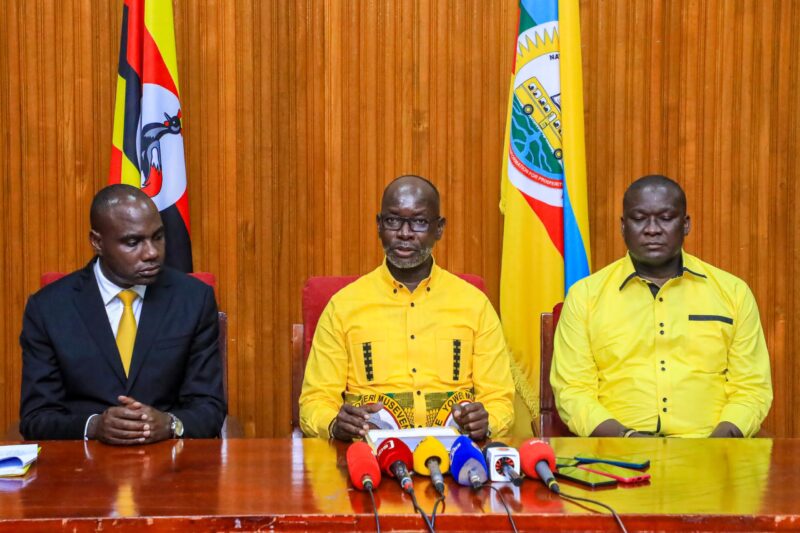
Members of the National Resistance Movement (NRM) Parliamentary Caucus have resolved to support the government’s budget priorities for the 2026/2027 financial year and the proposed Protection of Sovereignty Bill, 2025. The resolutions were reached during a caucus meeting held at State House Entebbe, following guidance from President Yoweri Museveni.
Addressing journalists at Parliament, Government Chief Whip Denis Hamson Obua, who also chairs the NRM Parliamentary Caucus, said members had agreed to support the forthcoming budget and to back the proposed Protection of Sovereignty Bill when it is introduced in Parliament. He noted that the caucus had aligned on key national priorities aimed at strengthening service delivery and advancing socio-economic transformation.
Among the priority areas highlighted are investments in peace and security, road infrastructure, electricity expansion, and railway development, as well as preparations for AFCON 2027 and the promotion of scientific innovation. The caucus also emphasized the importance of restocking programmes in the sub-regions of Teso, Lango and Acholi, alongside salary enhancements for public servants, including primary school teachers, secondary school arts teachers, BTVET staff, and security personnel.
State Minister for Finance Henry Musasizi revealed that the government is projecting a total resource envelope of approximately Shs84 trillion for the 2026/2027 financial year. He explained that this represents an increase from about Shs72 trillion in the current financial year, reflecting a rise of roughly Shs11.6 trillion to cater for the government’s priority programmes. Of the projected budget, about Shs44.5 trillion is expected to be generated from domestic tax revenue.
Musasizi further indicated that government has prioritized salary enhancements for teachers through a phased approach. He said a 25 percent increment has already been provided in the current financial year, with additional increments of 25 percent planned annually until a 100 percent salary increase is achieved within two years. The total cost of implementing this plan is estimated at Shs2.5 trillion, with about Shs500 billion already allocated.
He added that government plans to allocate approximately Shs1.38 trillion towards key infrastructure projects, including the Kampala–Jinja Expressway, the Standard Gauge Railway, and the expansion of electricity supply to industrial parks. The minister also pointed to planned tax measures and administrative reforms aimed at strengthening domestic revenue mobilisation and improving efficiency within the Uganda Revenue Authority.
The resolutions from the NRM Caucus signal a unified position within the ruling party to support government policy direction, particularly in financing critical development priorities, improving public sector remuneration, and advancing legislative measures such as the proposed sovereignty law.
