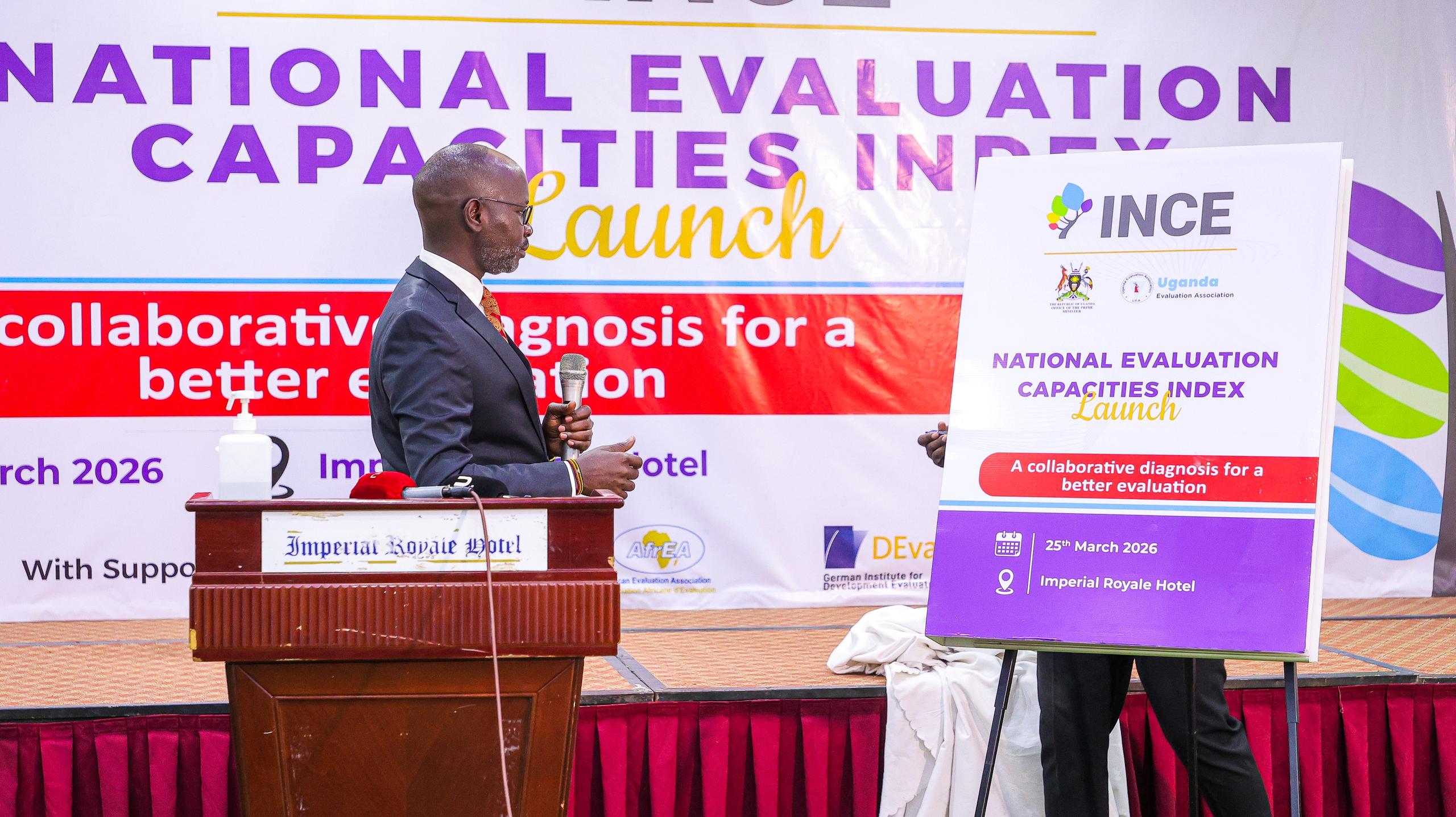


The Government Chief Whip, Denis Hamson Obua, has called for the strengthening of an evaluative culture across government institutions to enhance evidence-based decision-making and improve public service delivery.
Obua made the remarks while representing Rt. Hon. Justine Kasule Lumumba, Minister in Charge of General Duties in the Office of the Prime Minister, at the launch of the National Evaluation Capacities Index (INCE) held at Imperial Royale Hotel in Kampala. The event was organized by the Office of the Prime Minister (OPM) in partnership with the Uganda Evaluation Association.
Speaking at the launch, Obua emphasized that under the leadership of the National Resistance Movement (NRM) government, building a strong evaluative culture is considered a key condition for effective and efficient service delivery.
He noted that such a culture enables the generation and use of impartial and reliable evidence to inform government programs, policies, and development interventions.
Obua further highlighted that President Yoweri Museveni has consistently championed public participation in government development programs, describing it as critical in ensuring that government initiatives respond to the real needs and priorities of citizens.
“Public participation allows government to better understand the needs of the people and to design development interventions that address those needs effectively. This makes it important to continuously generate evidence through monitoring, reviews, and evaluation,” Obua said.
He explained that an evaluative culture is built on shared values and beliefs that prioritize the systematic collection and use of information on development programs. He cited the Government Performance Assessment framework as an example of how evaluation mechanisms are being used to ensure that information on government performance contributes to improving service delivery.
Obua expressed optimism that the INCE initiative launched at the event will strengthen Uganda’s evaluation systems and support the delivery of quality public services.
He said the initiative must involve the entire evaluation ecosystem, including government institutions, Parliament, oversight bodies, civil society organizations, universities, and development partners.
“Evidence must not gather dust in reports; it must inform decisions, shape budgets, and drive the continuous improvement of public service delivery,” Obua said.
The National Evaluation Capacities Index is expected to provide a tool for assessing and strengthening evaluation practices across institutions in Uganda, with the aim of improving accountability and effectiveness in the implementation of development programs.